



Machar urges more constitutional courts, legal practitioners at local levels

First Vice President Dr. Riek Machar suggests the establishment of more constitutional courts at the local levels and deconcentration of legal practitioners to promote and improve access to justice in all parts of the country.
Dr. Machar advised the Ministry of Justice and Constitutional Affairs that such a move will popularize the legal profession by creating employment opportunities for law graduates and encouraging more students to study the field.
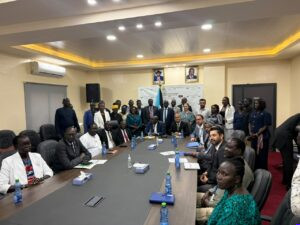
Addressing the launch of the 2023-2026 strategic plan of the ministry, the first vice president called for the transfer of advocates and other legal practitioners to the states, counties, and payams instead of being stationed in Juba.
“Since we became independent, how many legal professionals have we produced in our universities? Are we still producing? It is you (the minister) who will have to make the legal profession popular,” he said on Wednesday.
“If access to justice is going to be available without difficulties, we need more legal persons in the states, in the counties, and even sometimes to the level of the payams. We should popularize the legal profession so that many of our young people join it.”
“For us to access justice, we need many advocates; they should not be concentrating in Juba. So, let the ministry lead in planning for such a situation.”
Dr. Machar further underscored that justice and accountability are key to lasting peace in the country.
“If there is justice in our society, our people will enjoy peace, and therefore, it is one of the areas that we as a government and as a people should appreciate having such departments in universities; the market is there, and the justice administration at all levels is there.”
“The judiciary, if it expands itself, should be able to absorb these people, so this is when our society will be peaceful.”
“I’m told most of the litigation in our country is still customary because the customary courts are the ones handling most of the litigation. But I think it is because of a lack of access to tertiary courts; if we do more, we will reduce this percentage.”
The South Sudan government struggles to provide effective legal services for the most vulnerable South Sudanese populations due to conflicts, according to Search for Common Ground.
It adds that the absence of a well-established justice system, coupled with the limited ability of civil society to address critical gaps in current justice practices, has limited citizens’ capacity to demand effective legal remedies.
The legal system in South Sudan is built on the combination of statutory and customary laws, and while the country has enacted dozens of laws since 2005, their use in legal disputes and courts is limited, says an overview by legal experts, published in New York University’s School of Law.
It further states that poor dissemination of laws, little experience with the new statutory provisions, the difficulty of many legal staff in understanding English, and lack of access to statutory courts limit the relevance of the new laws.