



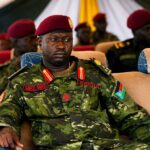


Lobong tells Yakani: We don’t have powers over border issues

Eastern Equatoria State governor, Louis Lobong Lojore, has dismissed a call by an activist on states sharing international borderlines with neighboring countries to resolve border issues instead of relying on the national government.
On August 5, Edmund Yakani, the Executive Director for Community Empowerment for Progress Organization (CEPO), hinted that governors should take the responsibility on such disputes and act at the interest of the residents along border areas.
The activist argued that the governors have an immediate bureaucracy under their leadership to prevent encroachment by neighbors into South Sudan territory.
Responding to the comments, Governor Lobong said state governments have no powers to discuss border issues.
Lobong said his government roles and responsibilities are limited to discussing peaceful coexistence among communities living in the disputed areas.
“The state or the local government has no powers to discuss issues of the borders, but they have the roles and responsibilities to discuss peaceful coexistence among the communities living along the borders,” he said, in an interview with Eye Radio.
“This is what we have been doing from time to time. We have educated our people to leave the issue of the border with the two governments of Uganda and South Sudan.”
“We have also told them across raiding and poaching is not allowed but free movements through designated check points are allowed.”
The modern-day international boundary between South Sudan and Uganda has its origins as a colonial administrative line separating Anglo–Egyptian Sudan from the Uganda Protectorate, both colonies then managed by the United Kingdom.
Today, it runs from the tripoint with Kenya in the east for approximately 500 km to the tripoint with the Democratic Republic of the Congo in the west.
However, there are several locations on the boundary that were originally described in unclear terms, which have led to at least two areas of boundary disputes between South Sudan and Uganda.
According to Sovereign Limits, lack of government control, problems with refugees, and general lawlessness in border regions have made demarcation and formalization of the international boundary between South Sudan and Uganda almost impossible.
Since June 2024, incidents of Ugandan encroachment into South Sudan have been reported in Magwi and Budi counties of Eastern Equatoria, where local farmers alleged harassment and displacement.
Apart from Magwi and Budi county border contention, another alleged encroachment has been reported in Kajo-Keji of Central Equatoria State, in which the Ugandan army is accused of constructing roads into South Sudan’s territory.
“So, yearly, monthly, we have cross border meetings, and the local government also at the county level have been communicating with their counterparts. This what we are doing but not discussing about where the borders are,” Lobong continued.
“The national government has already formed a committee and Uganda also has a border committee, they are meeting and they are discussing about it.”