



Renk farmers struggle with market surplus as Agriculture Ministry urges humanitarian purchase

Farmers in Renk County are facing a severe marketing crisis, with massive stocks of unsold agricultural produce remaining in storage—some dating as far back as 2024—prompting the National Ministry of Agriculture and Food Security to call for immediate intervention from relief agencies.
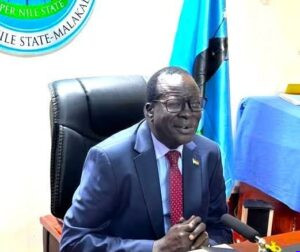
National Minister of Agriculture and Food Security, Clement Juma Mbugoniwia, raised the alarm on Friday following an inspection tour of local irrigation projects in Upper Nile State. He warned that the lack of buyers is eroding local agricultural incentives and threatening future food production cycles.
Minister Mbugoniwia specifically appealed to international aid organizations, particularly the World Food Programme (WFP), to procure local crops for their ongoing relief operations across South Sudan.
“We have seen for ourselves, there is a big number of products. Some of them date back to 2024 because they did not find buyers. This is discouraging many farmers from producing,” Minister Mbugoniwia stated during his visit. “With this amount of food, there is a need for NGOs, especially the World Food Programme and those engaged in relief efforts, to come to Renk and make use of these commodities.”
The marketing bottleneck adds to a growing list of systemic hurdles for Renk’s agricultural sector, including high fuel prices, inadequate credit access, crop pests, and major transport disruptions linked to the ongoing conflict in neighboring Sudan.
Compounding the crisis is a lack of institutional storage infrastructure. Santino Deng, Managing Director of the Agricultural Bank branch in Renk, clarified that the produce currently filling local silos belongs to individual farmers rather than state reserves.
“All the crops, including sesame, corn, and gum arabic stored in the silo, belong to the farmers, not the government. These quantities are the direct result of the farmers’ labor,” Deng explained. “We were unable to store last year’s harvest in these warehouses due to limited capacity, forcing farmers to keep their produce at home.”
Deng further noted that expected agricultural financing failed to materialize for the current planting season, leaving farmers severely undercapitalized as the season draws to a close.
Local officials and banking representatives warned that unless humanitarian actors step in to absorb the surplus and financial institutions unlock credit lines, Renk’s capacity to sustain high-volume food production will remain critically compromised.