New transitional period to count down from February 2025: Lomuro

After the South Sudan presidency agreed to delay long-awaited elections and reset the transitional period, Cabinet Minister Dr. Martin Elia Lomuro said the new transition will countdown from February 2025 with the few remaining months until then to be used for mobilizing peace implementation funds.
South Sudan was expected to hold its first-ever general elections since independence in December 2024, to end the transitional period after the establishment of a democratically elected government.
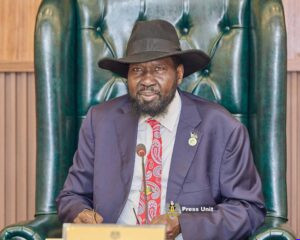
But on Friday, President Kiir and his five vice presidents reached a consensus to save the unity government from descending into legitimacy crisis, thus, empowering it to govern for another two years after which the polls will be conducted in late 2026.
The decision was reportedly reached because most of the critical peace provisions including security arrangement, permanent constitution making, electoral preparations and other issues, which could enable credible elections, remain pending.
The presidency had formed a committee to review progress in the August 2022 Peace Roadmap which invoked a similar two-year extension under the excuse that such would pave way for implementing crucial pending tasks outlined in the 2018 peace deal.
Dr. Lomuro said the High-Level Committee led by Presidential Advisor Tut Gatluak received reports from the National Constitutional Review Commission, National Election Commission, Political Parties Council and the National Bureau of Statistics.
He said the extension was agreed in response to the recommendations from both the electoral and security sector institutions.
“From all these reports, they made recommendations on three issues; first they did not complete all the tasks that are critical for the conduct of elections in December 2024, two; they needed us to postpone elections and approve extension of the transitional period,” he told state-owned television SSBC.
“We forwarded these reports to the presidency and the presidency has endorsed that elections be delayed according to the recommendations of the peace institutions.”
However, the presidency’s decision to extend the transitional period ought to be endorsed by the several institutions including the peace monitoring mechanism R-JMEC, the national cabinet and the parliament, according to the 2018 peace accord.
Minister Lomuro stated that the government will not be dissolved and will continue to function as usual while the institutions work to finalize their provisions.
“So the question of suspending government by September 22nd 2024 does not arise anymore. The government functions as usual. We have agreed to reset the transitional period to begin from February 2025 with elections to be conducted on 22nd December 2026.”
“Now, the first few months remaining from the current transitional period is used to mobilize fund so that we can now be sure that we will implement the agreement according to the new timetable.”
Article 8.4 of the R-ARCSS stipulates that the peace deal may be amended by the parties, with at least two/thirds of the members of the Council of Ministers, and, at least two-thirds of the voting members of the Revitalized Joint Monitoring and Evaluation Commission consenting to the amendment, followed by ratification by the Transitional National Legislature.
In August 2022, the South Sudan government signed a two-year extension of the transitional government to what Dr. Lomuro said was a move to address challenges that impede the implementation of the peace agreement, but which was widely criticized by some civil society groups and foreign partners.
President Kiir described the extension as the only option to save the country from sliding back to war while speaking at the signing ceremony of the extension that was boycotted by Troika nations including the United States, Britain and Norwa.